Building Layered Risk Models for Blackjack Sessions Using Real-Time Deck Composition Tracking in Land-Based Venues
Logan Bauer · Aug 1, 2026

Building Layered Risk Models for Blackjack Sessions Using Real-Time Deck Composition Tracking in Land-Based Venues
Land-based blackjack operations rely on precise management of deck composition to shape session outcomes, and operators have developed layered risk models that incorporate real-time tracking data from physical venues. These models combine multiple data layers including running counts, true counts adjusted for remaining decks, and variance estimates drawn from ongoing shoe progress. Observers note that facilities in major markets such as Nevada and Atlantic City began integrating electronic tracking aids as early as the mid-2010s, yet the approach gained broader adoption when hardware costs declined and software interfaces improved.
Core Elements of Deck Composition Tracking
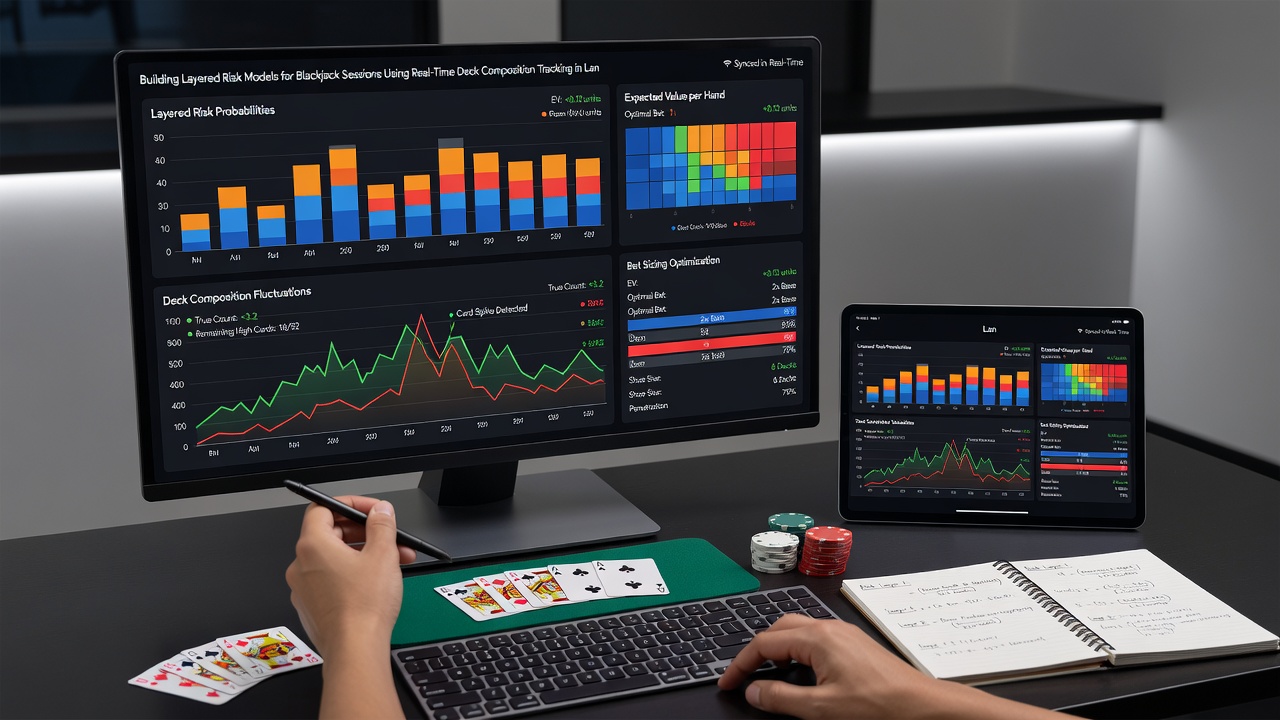
Real-time deck composition tracking starts with continuous monitoring of cards removed from the shoe, which produces an updated ratio of high-value to low-value cards still in play. Systems capture each card via overhead cameras or RFID-enabled tables, then feed the information into algorithms that recalculate probabilities after every hand. Research indicates that accurate composition data allows operators to adjust table minimums or staffing levels dynamically, while players who employ similar tools focus on session-level exposure rather than single-hand decisions.
Layer one of most models consists of a basic running count that tallies the net value of observed cards according to standard systems such as Hi-Lo. Layer two converts that count into a true count by dividing by the estimated number of decks remaining, and layer three overlays volatility measures that account for bet spread limits and table penetration. Data from multiple venues shows that adding a fourth layer for dealer-specific tendencies and a fifth layer for session duration produces more stable risk projections across an evening of play.
Implementation Challenges in Physical Settings
Land-based environments introduce variables absent from digital platforms, including manual shuffling procedures, multiple simultaneous tables, and variable lighting conditions that affect optical recognition accuracy. Technicians address these issues by calibrating camera arrays at regular intervals and cross-referencing optical reads with dealer-reported card totals. Figures from the Nevada Gaming Control Board reveal that establishments reporting integrated tracking systems experienced a measurable reduction in unresolved count disputes between 2023 and 2025.
Integration with existing surveillance networks remains a key hurdle. Many properties route the composition feed through the same fiber backbone that carries security footage, which requires careful bandwidth allocation to avoid latency spikes during peak hours. One study conducted at a Canadian provincial casino documented average processing delays of under 800 milliseconds when the system handled six concurrent tables, confirming that current hardware supports near-instantaneous updates.
Data Sources and Model Calibration
Calibration draws from both internal session logs and external benchmarks published by academic gaming research centers. Analysts compare predicted versus actual outcomes across thousands of hands to refine weighting coefficients within each layer. Reports issued by the Australian Institute of Criminology highlight that venues maintaining six-month rolling datasets achieve tighter confidence intervals around projected hold percentages than those relying on shorter observation windows.
External regulatory filings also supply useful calibration points. The New Jersey Division of Gaming Enforcement publishes monthly tables that list average deck penetration and hand volume per table, figures that model builders incorporate when scaling risk parameters across different jurisdictions. Observers note that cross-referencing these public datasets with proprietary logs helps identify regional deviations caused by local shuffle techniques or house rules.
Session-Level Risk Layering
Once composition data flows continuously, the model layers additional risk controls that address bankroll allocation and stop-loss thresholds. A session might begin with a baseline bet unit sized according to the opening true count, then scale upward only when multiple layers align on favorable composition. Risk managers program automated alerts that flag when cumulative exposure exceeds predefined percentages of the session bankroll, prompting either bet reduction or temporary table departure.
Those who have examined operational records at large properties report that layered models frequently incorporate a time-decay factor that reduces confidence in early-shoe readings as cards are removed. This adjustment prevents overexposure during the first few hands when remaining deck estimates carry higher uncertainty. The approach has proven particularly useful in high-limit rooms where single-hand variance can quickly erode session equity.
Conclusion
Layered risk models built around real-time deck composition tracking continue to evolve in land-based blackjack operations as hardware reliability increases and regulatory reporting requirements expand. Facilities that maintain comprehensive data pipelines gain clearer visibility into session dynamics, while the underlying statistical frameworks remain grounded in established probability calculations. Continued refinement of these systems will depend on the quality of input data and the ability to integrate new sensor technologies without disrupting established floor procedures.